Latest News
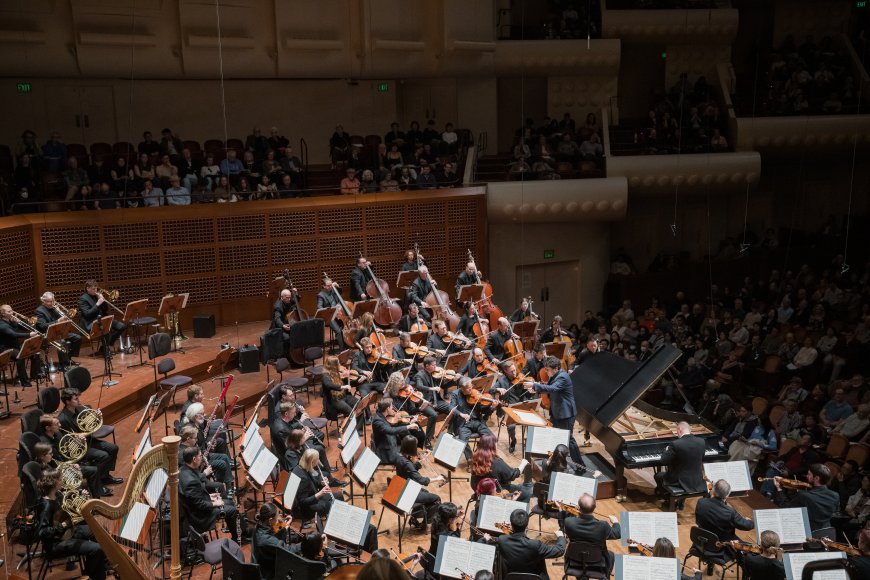
The conductor carried all of that nuance forward into exciting performances of Rachmaninoff’s First Piano Concerto, with Macedonian pianist Simon Trpčeski. Rachmaninoff was a great piano virtuoso of the late Romantic era. Since he wrote for himself, his piano music calls for extreme keyboard athletics. Trpčeski has technique to burn and brought it all to bear on the concerto, playing with both fire and romanticism. Măcelaru proved a superb partner, and the two combined for a wondrous degree of rhythmic freedom throughout.
Trpčeski’s ability to spin out a filigreed line or project power ideally suited the first movement, and he played with melting tenderness at the start of its cadenza. The close of the movement built so passionately that the audience was — appropriately — moved to applause.
Trpčeski nodded to the audience with a smile, then went on with the concerto. The ruminative, understated piano entrance gave him the opportunity to toy with the crowd’s emotions, as he and Măcelaru deeply embraced the Romantic side of the work.
Rachmaninoff’s wit emerged as well, and that carried over into the warmly romantic elegance of the third movement opening. Trpčeski played the sweet second section with a hint of longing, and the crisp closing phrases added a circus-like rush to the conclusion.
A well-deserved standing ovation brought the pianist back for two encores. In a brief speech before the first, Trpčeski noted his pleasure in returning after an eight-year absence, and at a momentous turning point for the Symphony. He dedicated the first encore to Chan, who was seated in Loge A with Symphony CEO Matthew Spivey, bringing another roar from the audience.
The pounding third movement of Prokofiev’s Piano Sonata No. 7 made a splendid encore to the Rachmaninoff, but Trpčeski still couldn’t make his exit. Out came a stagehand with a music stand for associate concertmaster Wyatt Underhill.
The pianist dedicated this encore, Evgeny Svetlanov’s brief and delightful “Two Simple Tunes,” to the Symphony’s beloved music director laureate, Michael Tilson Thomas, who died last month nearly five years after being diagnosed with glioblastoma multiforme, an aggressive brain cancer.


