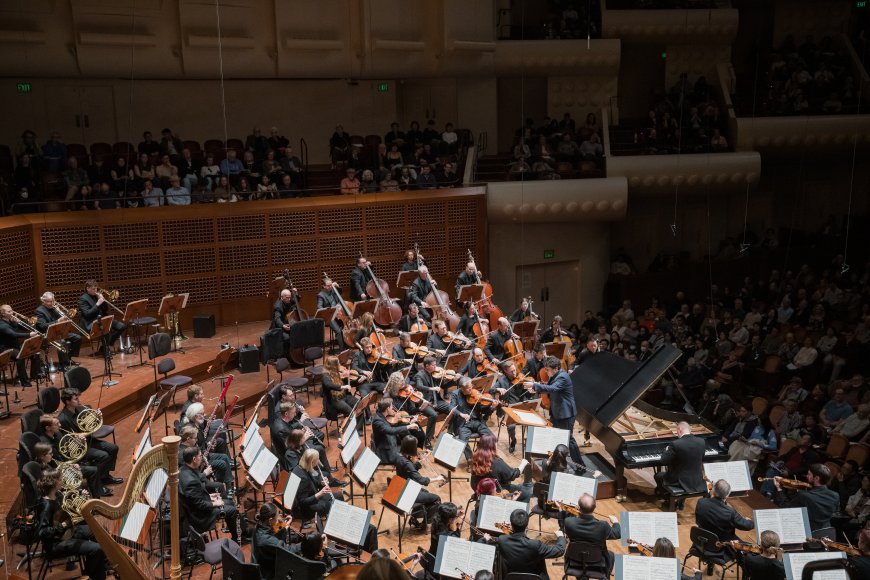
"The best thing to come out of Macedonia since Alexander the Great is pianist Simon Trpčeski... the pianist is pretty good at conquering audiences as well as scores, not only with his playing but also with an engaging manner that connects with his listeners."
THE SEATTLE TIMES
Per Aspera Ad Astra — My art is dedicated to all those who aspire — Симон Трпчески

Biography

Macedonian pianist Simon Trpčeski has established himself as one of the most remarkable musicians on the global stage, performing with over 100 orchestras on four continents, with leading conductors and at the most prestigious venues. Mr. Trpčeski is recognized for his powerful virtuosity and deeply expressive approach, as well as his charismatic ability to connect with diverse audiences worldwide and his commitment to strengthening Macedonia’s cultural heritage.

Mr. Trpčeski has collaborated with a long list of prominent conductors, including Lorin Maazel, Vladimir Ashkenazy, Marin Alsop, Gustavo Dudamel, Gianandrea Noseda, Charles Dutoit, Antonio Pappano, Michael Tilson Thomas, Cristian Măcelaru, and Vasily Petrenko.  As an experienced pianist, he is also a popular collaborator among the next generation of high-profile conductors, including Jakub Hruša, Gabriel Bebeșelea, Dalia Stasevska, Elim Chan, Alpesh Chauhan, and Dima Slobodeniuk.

Read Full Bio

Upcoming Performances

February 28, 2026
@
7:00 pm
Bucharest, Romania — Chamber Music at The Romanian Athenaeum
Type
Chamber Music
Orchestra
Conductor
Venue
Romanian Athenaeum - Great Hall
Repertoire
Joseph Haydn Piano Trio in G major, Hob.XV:25 Dmitri Shostakovich Piano Trio No. 2 in E minor, Op. 67 Johannes Brahms Piano Quartet No. 3 in C minor, Op. 60
Get Ticket →
March 6, 2026
@
11:30 am
Washington D.C. — National Symphony Orchestra & Gianandrea Noseda
Type
Concerto
Orchestra
National Symphony Orchestra
Conductor
Gianandrea Noseda
Venue
The Kennedy Center
Repertoire
Saint-Saëns Piano Concerto No. 5
Get Ticket →
March 7, 2026
@
8:00 pm
Washington D.C. — National Symphony Orchestra & Gianandrea Noseda
Type
Concerto
Orchestra
National Symphony Orchestra
Conductor
Gianandrea Noseda
Venue
The Kennedy Center
Repertoire
Saint-Saëns Piano Concerto No. 5
Get Ticket →
View All Performances

Latest News

February 27, 2026
Radio România Muzical: Interview with Pianist Simon Trpčeski

You have performed frequently in Romania since 2015 and have even said that you feel at home in our country. How has your relationship with the Romanian public evolved over time?

I came to Bucharest, as part of the Enescu Festival, in the 2015 edition, and then I returned for the Cluj Musical Autumn, where I presented my project Makedonissimo. After that, I started to return to Romanian stages more often, being honored by the invitation to perform in several cities, in Cluj, in Timișoara (as an artist in residence, a collaboration that is still ongoing) and, of course, several times in Bucharest, where I performed in the company of several orchestras. My last visit was to the Enescu Festival in September, thanks to the invitation of maestro Măcelaru.

In all these years, I have had the opportunity to reconfirm the feeling that the Romanian public, which is closely linked to the Romanian culture, is in some way linked to the culture of my homeland, Macedonia, and I think there could not have been a more natural connection between the two. I am very grateful that the Romanian public, especially in Bucharest - thanks to an important tradition and the opportunities to bring internationally renowned artists - can keep in touch with the latest news of the concert scene in Europe and not only, from all over the globe, especially through the Enescu Festival, but also through the seasons of the Philharmonic Orchestra and the Radio Orchestras that bring important names of the musical world to Bucharest. Therefore, the public can get in touch with these artists and develop their own standards or expectations; all this, together with the education and culture they have acquired throughout history. I can only say that I am happy for the recognition of my art and for all the moments I have experienced together with the music lovers of Aucu, from a musical point of view - on stage, but also off. Every time I return to a Romanian stage has been received with great warmth and kindness and of course this is a great inspiration and motivation for an artist, so I am always happy to return to Romania!


You also have very good relations with Romanian musicians, with many of them becoming friends. During the recital on February 28 at the Romanian Athenaeum, you will perform alongside two Romanian artists. How did the idea of ​​this collaboration come about?

In a very spontaneous way, when I came to the Enescu Festival. It's actually something I do often, I invite someone from the orchestra to sing the encore with me. Even before arriving in Bucharest, I asked for the contact of the concertmaster, Theodor Andreescu, without knowing him beforehand, of course, and his affirmative answer came very quickly. I felt his positivity and I sang the encore for the first time live, right on stage. I think spontaneity is very precious and I really appreciate people who are so open to such proposals. I think this message about unity and friendship that I try to convey to musicians, but also to the audience, is very important in these times that we are living now, and music can help us overcome all these things and can unite us. And after that encore, Theodor was so surprised by what we managed to create together, without any rehearsal, and by my personality, so he proposed a recital to me. I am very grateful for such people! We will be playing with the cellist Alexander Somov, a colleague and dear friend, who is the first cellist of the Strasbourg Philharmonic Orchestra, is from Bulgaria and is part of the quintet of my project, Makedonissimo. He is a fantastic person and musician! And I met Sorin Spasinovici when I collaborated with the European Union Youth Orchestra and this is a new example of a meeting that gives birth to friendships in a very spontaneous way. We were studying in adjacent rooms and, without knowing that he was from Romania, I asked him to play with me and a Bulgarian cellist the encore of that concert, a Macedonian piece. I was amazed by his abilities and by him as a person and since then we have become friends and collaborated several times. We recorded the Brahms Quartet together during the pandemic, the album being called "Friendship" because it was made in very difficult conditions, then several artists came from different countries to Macedonia especially for that recording session. So I'm glad I have the chance to sing with him for the first time in his country.


How important is chamber music in your work?

Chamber music means friendship, and when you play with the same band members for a long time, it's like being in a family! And sharing emotions with others is the most beautiful and natural thing in people's lives, and musicians in particular. Unfortunately, I don't have the opportunity to play chamber music as much as I would like, so I respond positively to the opportunities that arise because, of course, it's a rich and very beautiful repertoire, and then, if you have other musicians with whom you get along very naturally, it's a real joy! It's actually like a revelation! It also occupies a very special place in my musical activity, and this may also explain why I prefer to play concert works more than solo recitals. Playing with an orchestra is a different kind of chamber music, or at least, this is my approach to this repertoire and my type of musical personality, and every time I play with an orchestra, the audience can feel this.

Read More →
View AlL News
By clicking “Accept”, you agree to the storing of cookies on your device to enhance site navigation, analyze site usage, and assist in our marketing efforts. View our Privacy Policy for more information.