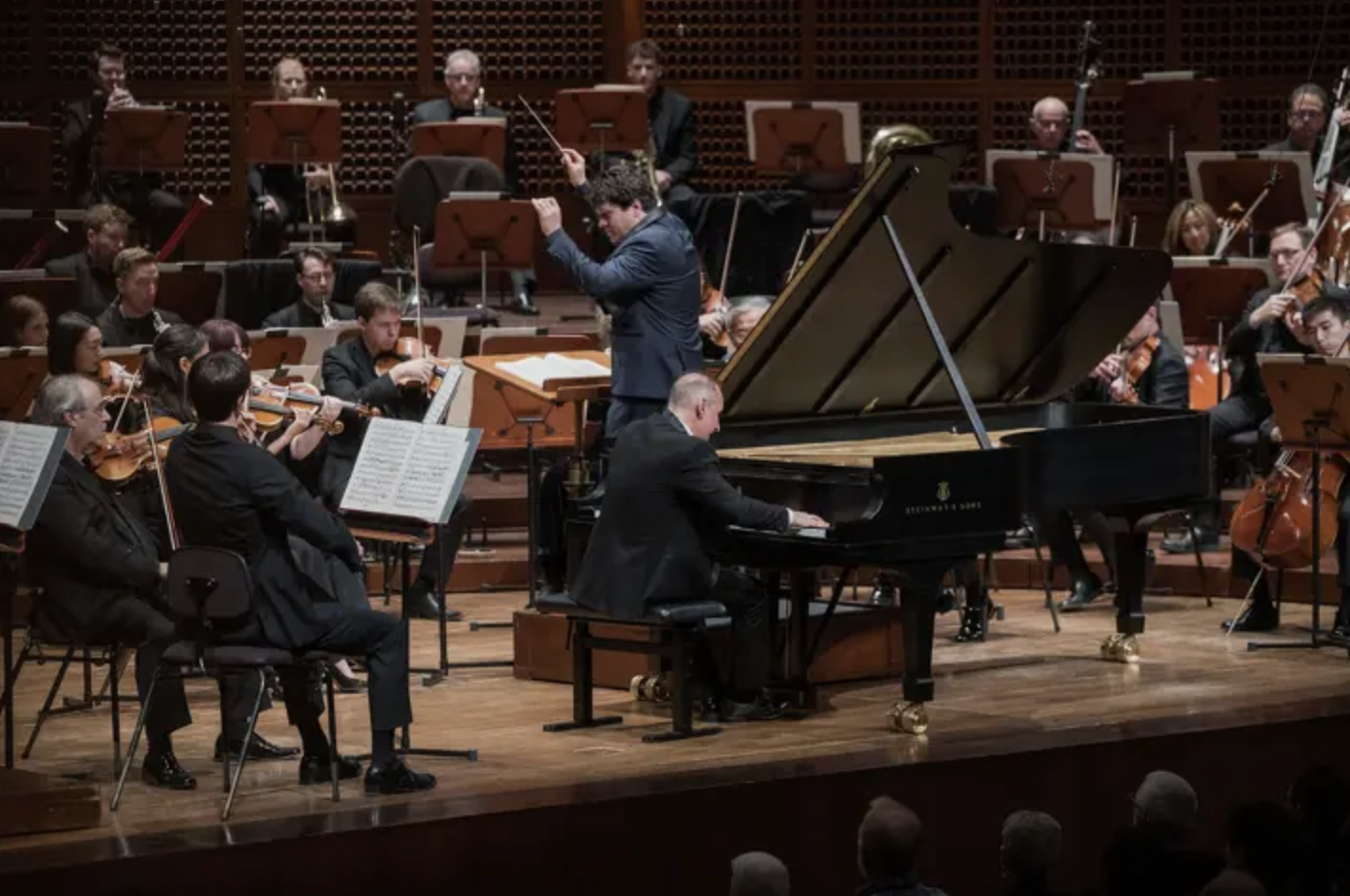
Rachmaninoff was a great piano virtuoso of the late Romantic era. Since he wrote for himself, his piano music calls for extreme keyboard athletics. Trpčeski has technique to burn and brought it all to bear on the concerto, playing with both fire and romanticism. Măcelaru proved a superb partner, and the two combined for a wondrous degree of rhythmic freedom throughout.
Trpčeski’s ability to spin out a filigreed line or project power ideally suited the first movement, and he played with melting tenderness at the start of its cadenza. The close of the movement built so passionately that the audience was — appropriately — moved to applause.
Trpčeski nodded to the audience with a smile, then went on with the concerto. The ruminative, understated piano entrance gave him the opportunity to toy with the crowd’s emotions, as he and Măcelaru deeply embraced the Romantic side of the work.
A well-deserved standing ovation brought the pianist back for two encores. In a brief speech before the first, Trpčeski noted his pleasure in returning after an eight-year absence, and at a momentous turning point for the Symphony. He dedicated the first encore to Chan, who was seated in Loge A with Symphony CEO Matthew Spivey, bringing another roar from the audience.
The pianist dedicated this encore, Evgeny Svetlanov’s brief and delightful “Two Simple Tunes,” to the Symphony’s beloved music director laureate, Michael Tilson Thomas, who died last month nearly five years after being diagnosed with glioblastoma multiforme, an aggressive brain cancer.

Born in Skopje, virtuoso pianist Simon Trpčeski is one of the most sought-after pianists today! With his powerful pianism and deeply expressive and unique interpretations, he won not only the hearts of listeners in concert halls around the world, but also left critics with only one choice: reviews of his concerts are turned into panegyrics! He performed as a soloist with the world's largest orchestras such as the New York Philharmonic, the San Francisco Symphony, the City of Birmingham Symphony Orchestra and the London Royal Philharmonic Orchestra, with whom he performed last season in the Lisinski Saturday cycle.

Macedonian pianist Simon Trpčeski and his international group also treated us to a newish piece by another Macedonian, Pande Shahov, in a nicely-proportioned programme that started with high seriousness and ended with a fluffy-light soufflé.

The pair began with Mozart’s Violin Sonata in E minor K304 – a genial, if subdued opening. Vengerov’s rivers of legato were even more delectable when combined with the sonorities from his 1727 ‘Kreutzer’ Stradivari. Prokofiev’s First Violin Sonata upped the temperature considerably, with Vengerov in high-concentration mode during the eerie filigree passages. Rough-hewn lunges during the second movement were tempered with sweetness, while Trpčeski felt like an amiable demon at the piano. The mellow, introspective Andante eventually yielded to the reprise of the violin filigree in the finale, returning like a love letter.

Listen to Simon Trpčeski's interview on BBC Radio 3's In Tune together with Maxim Vengerov talking about their upcoming concert on January 10 in London's Barbican Hall. January 7 at 17:00 GMT / 18:00 CET

The wondrously talented Macedonian pianist Simon Trpčeski opens daringly with Brahms’s wistful Intermezzo, Op117, before a dazzlingly reading of the Op24 Variation and Fugue on a theme by Handel. Then the totally different soundworld of Ravel’s Valses nobles et sentimentales bursts forth in all its dizzying glamour, before a selection of Poulenc’s charming Novelettes and Improvisations brings this masterly recital to a classy close. A disc to savour. Highly recommended.