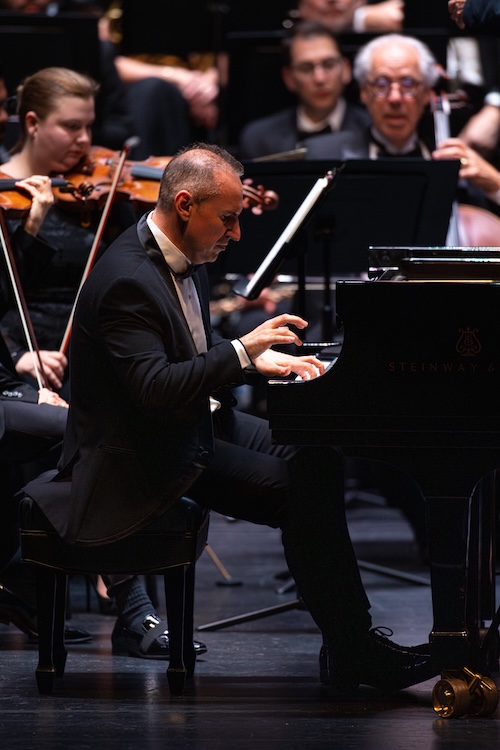
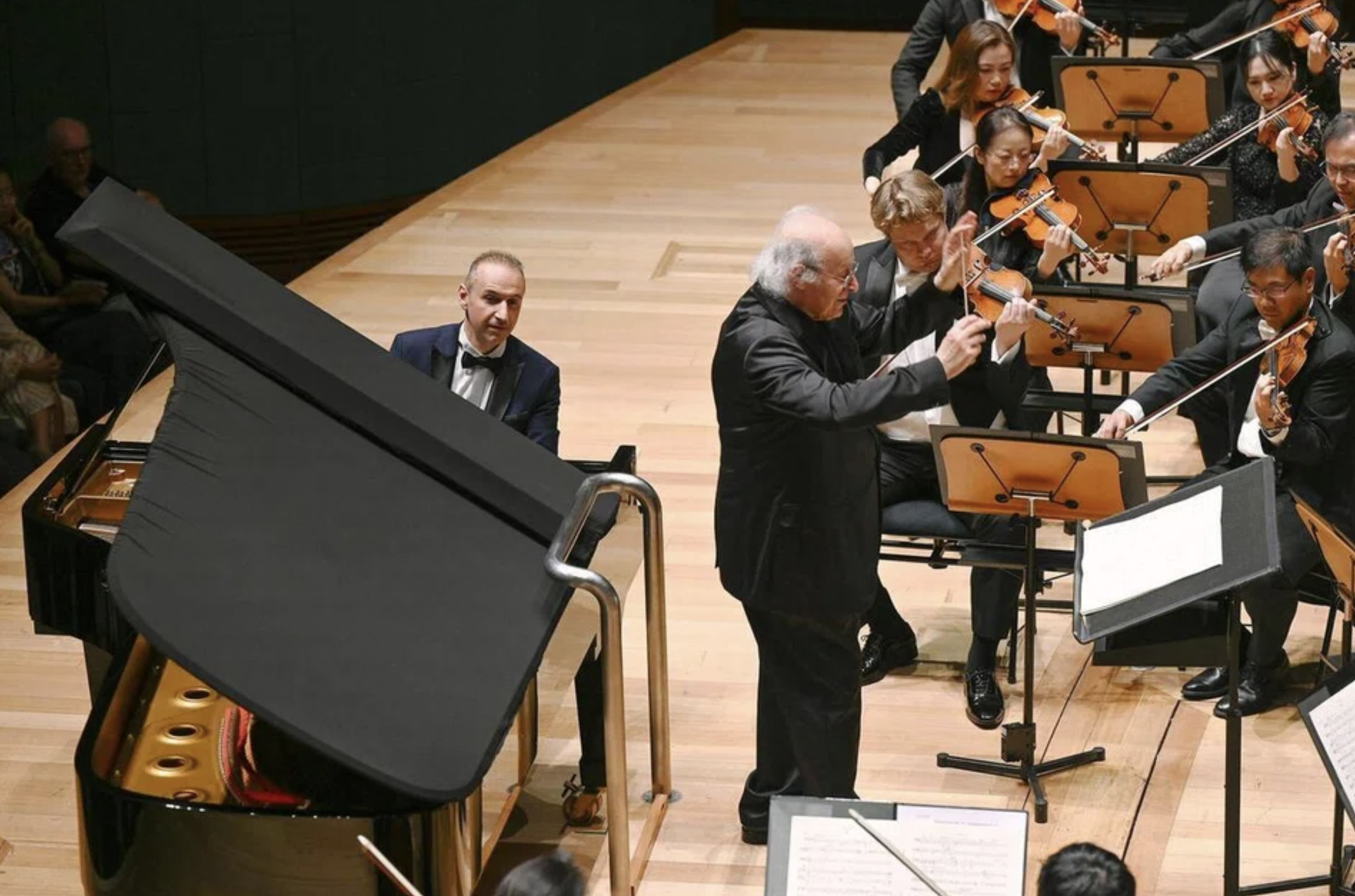
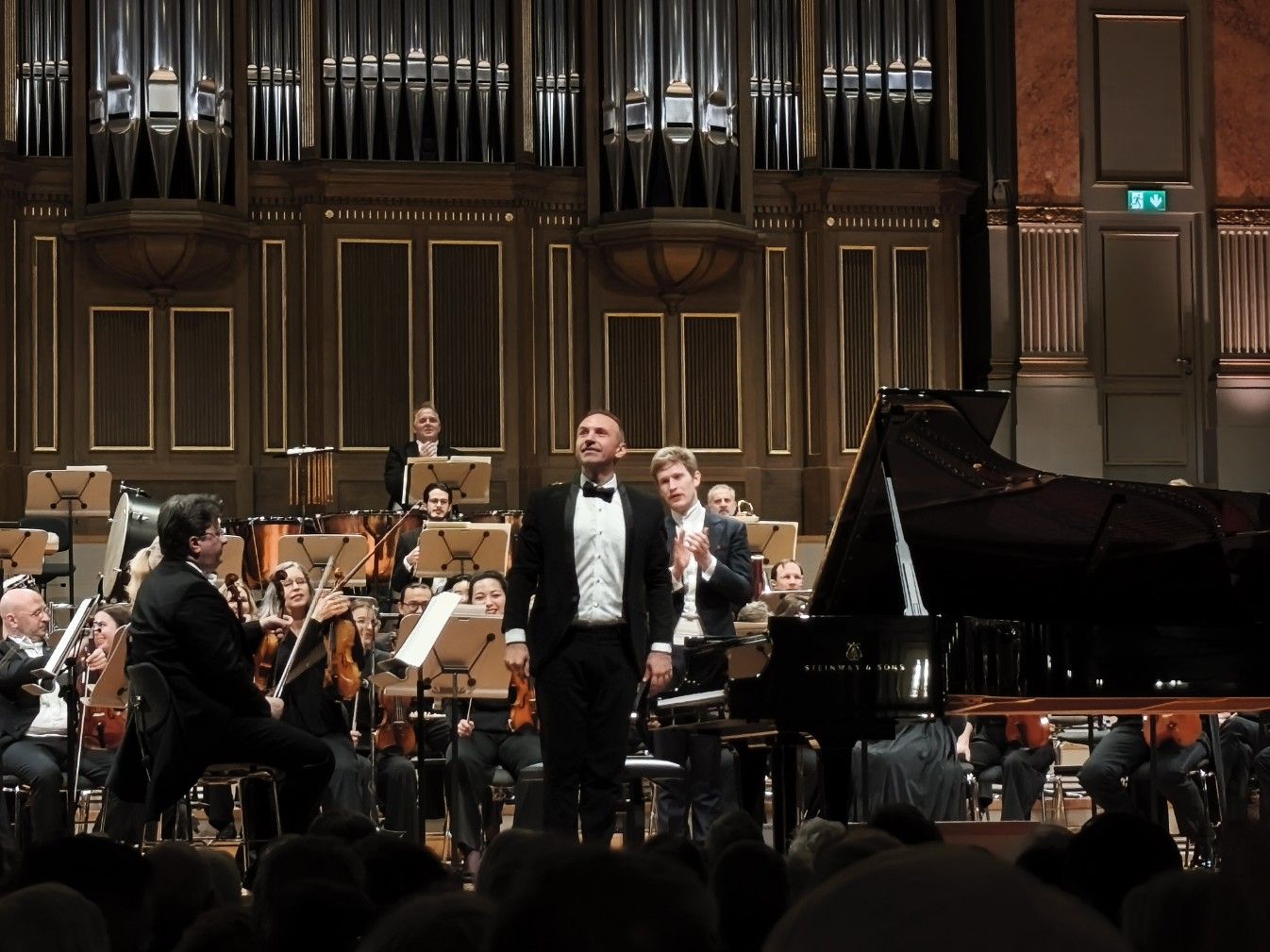
Opening with Rachmaninov’s Piano Concerto no. 2 in C minor, Op.18, Inbal kept the orchestra in sync with Macedonian pianist Simon Trpčeski, whose approach was loose and easy, happy to do the accompanying as orchestral strings sang the big tune, and coming in from the cold for solo flourishes. There was neither coming on strong nor gilding the lily, and there were moments in the first movement when the orchestra almost drowned out the piano. No such worries in the Adagio sostenuto central slow movement, when the piano’s solo line sang out unabated, in a gradual unwinding that climaxed in a brilliant solo cadenza. The strings accompanying piano chords at its denouement provided the concerto’s most sublime moment. The finale was a thrilling white knuckle ride. Trpčeski’s treatment of the big melody was initially subdued and the intention was to work its way to a glorious apotheosis, before which a central fugato section was negotiated with the skill of a high-wire act.
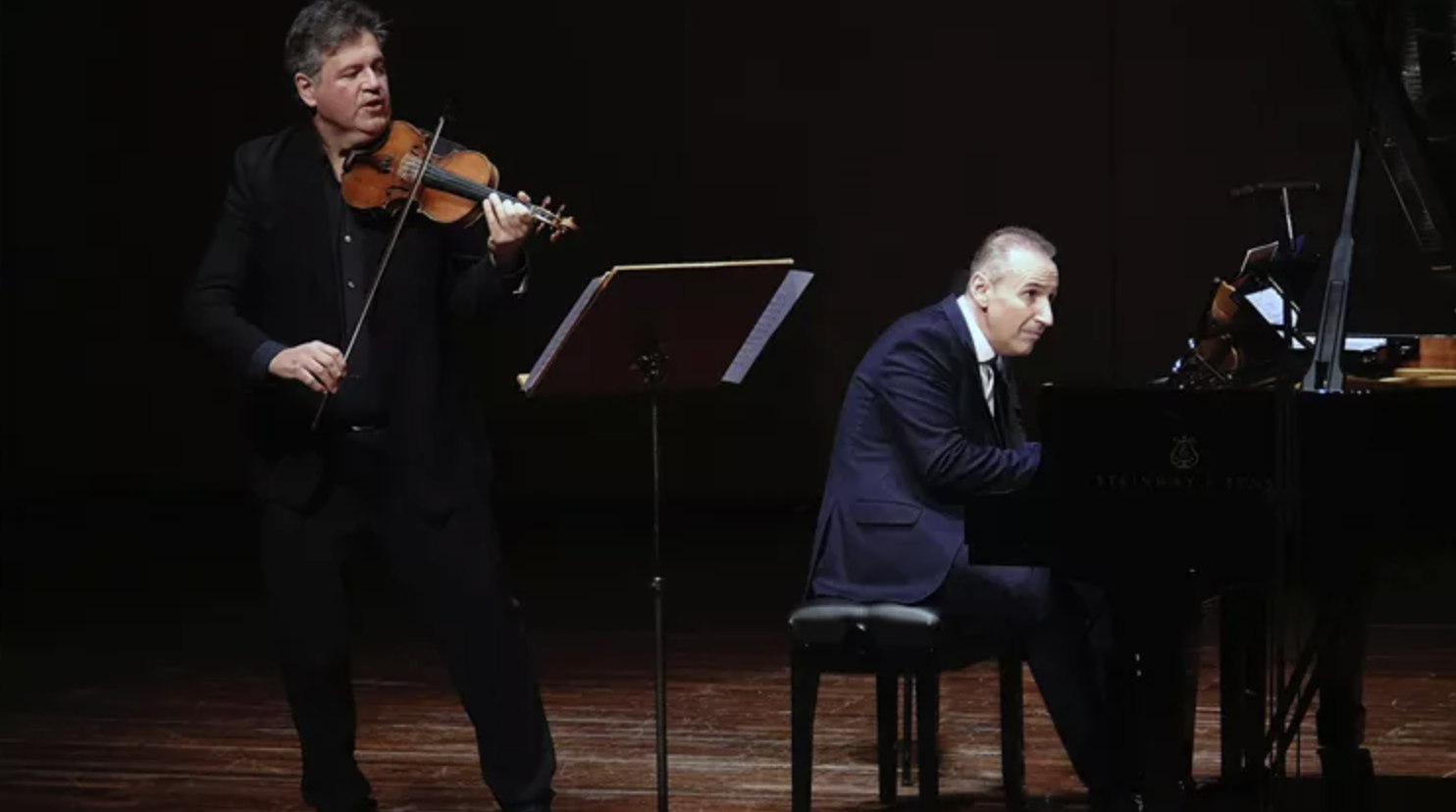
The close was predictably splashy, drawing a chorus of cheers, followed by two vastly varied encores. The Precipitato finale from Prokofiev’s Seventh Sonata was devastating in its drive, contrasted with Rachmaninov’s serene Vocalise, Op.34 no.14, with guest concertmaster David Coucheron on violin. The latter was dedicated to the memory of Hans Sørensen, the former SSO Director of Artistic Planning who passed away unexpectedly in January, and a plea for world peace.

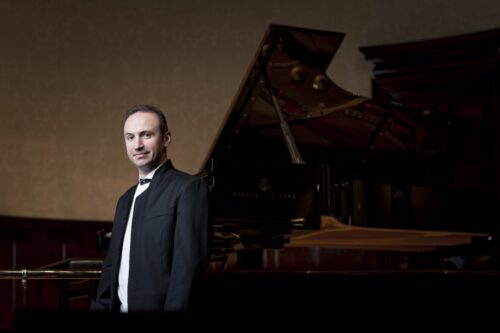
Pianist Simon Trpčeski has been billed as “the best thing to come out of Macedonia since Alexander the Great”.
While Trpčeski has never invaded Persia, he shares with his fellow Macedonian a certain uncomplicated boldness and a flair for the conquest of difficult obstacles, as evidenced by his fresh, athletic performance of Rachmaninoff’s second piano concerto with a well-oiled Singapore Symphony Orchestra (SSO) under the inspired nonagenarian conductor Eliahu Inbal.
This was a performance of dynamism, dexterity and Mediterranean directness, not the hypnotic concentration of a Sviatoslav Richter or the patrician eloquence of a Garrick Ohlsson (who played the work with the SSO in a very different interpretation two years ago).
Trpčeski is a natural showman who reveled in tricky passages with the elan of a magician pulling a rabbit out of a hat. The outer movements were taken at a thrilling pace, to great effect in more frenetic moments such as the piano’s keyboard-spanning entrance in the last movement.
However, the same movement’s coda felt less like an exhilarating summit push and more like a breathless scramble towards the finish line.
There were a few uneasy moments in the first movement, with Trpčeski’s lithe, clean sound sometimes failing to project adequately over the orchestra. One also missed the neurotic heartsickness at the core of the work, particularly in the second movement, whose long-spun melodies often felt declamatory rather than confessional.
This was not helped by Inbal and the SSO’s tendency to insert pauses that felt just a shade too precious between each bar of the main theme.
Nonetheless, it was a brilliant, energetic performance that earned a well-deserved standing ovation.
Trpčeski's two encores were exceptional. The last movement of Prokofiev’s 7th sonata was delivered with jaw-dropping technique and all the deranged automatism of the assembly line in Chaplin’s Modern Times.
The second was a performance of Rachmaninoff’s Vocalise in which Trpčeski accompanied guest concertmaster David Coucheron. It was prefaced by some engaging remarks about Trpčeski's love of Singapore and music’s peace-making powers amid world disorder, and was as unexpected as it was touching.
_B.%20Ealovega_S.Spirovski_KulturOp_3.jpg)
Andrew Lim chats with the Macedonian pianist who is in Singapore to play Rachmaninoff's 2nd piano concerto with the Singapore Symphony Orchestra conducted by Eliyahu Inbal. Simon thinks Singapore is a well-organized paradise! Hear his thoughts on Rach 2.

You have performed frequently in Romania since 2015 and have even said that you feel at home in our country. How has your relationship with the Romanian public evolved over time?
I came to Bucharest, as part of the Enescu Festival, in the 2015 edition, and then I returned for the Cluj Musical Autumn, where I presented my project Makedonissimo. After that, I started to return to Romanian stages more often, being honored by the invitation to perform in several cities, in Cluj, in Timișoara (as an artist in residence, a collaboration that is still ongoing) and, of course, several times in Bucharest, where I performed in the company of several orchestras. My last visit was to the Enescu Festival in September, thanks to the invitation of maestro Măcelaru.
In all these years, I have had the opportunity to reconfirm the feeling that the Romanian public, which is closely linked to the Romanian culture, is in some way linked to the culture of my homeland, Macedonia, and I think there could not have been a more natural connection between the two. I am very grateful that the Romanian public, especially in Bucharest - thanks to an important tradition and the opportunities to bring internationally renowned artists - can keep in touch with the latest news of the concert scene in Europe and not only, from all over the globe, especially through the Enescu Festival, but also through the seasons of the Philharmonic Orchestra and the Radio Orchestras that bring important names of the musical world to Bucharest. Therefore, the public can get in touch with these artists and develop their own standards or expectations; all this, together with the education and culture they have acquired throughout history. I can only say that I am happy for the recognition of my art and for all the moments I have experienced together with the music lovers of Aucu, from a musical point of view - on stage, but also off. Every time I return to a Romanian stage has been received with great warmth and kindness and of course this is a great inspiration and motivation for an artist, so I am always happy to return to Romania!
You also have very good relations with Romanian musicians, with many of them becoming friends. During the recital on February 28 at the Romanian Athenaeum, you will perform alongside two Romanian artists. How did the idea of this collaboration come about?
In a very spontaneous way, when I came to the Enescu Festival. It's actually something I do often, I invite someone from the orchestra to sing the encore with me. Even before arriving in Bucharest, I asked for the contact of the concertmaster, Theodor Andreescu, without knowing him beforehand, of course, and his affirmative answer came very quickly. I felt his positivity and I sang the encore for the first time live, right on stage. I think spontaneity is very precious and I really appreciate people who are so open to such proposals. I think this message about unity and friendship that I try to convey to musicians, but also to the audience, is very important in these times that we are living now, and music can help us overcome all these things and can unite us. And after that encore, Theodor was so surprised by what we managed to create together, without any rehearsal, and by my personality, so he proposed a recital to me. I am very grateful for such people! We will be playing with the cellist Alexander Somov, a colleague and dear friend, who is the first cellist of the Strasbourg Philharmonic Orchestra, is from Bulgaria and is part of the quintet of my project, Makedonissimo. He is a fantastic person and musician! And I met Sorin Spasinovici when I collaborated with the European Union Youth Orchestra and this is a new example of a meeting that gives birth to friendships in a very spontaneous way. We were studying in adjacent rooms and, without knowing that he was from Romania, I asked him to play with me and a Bulgarian cellist the encore of that concert, a Macedonian piece. I was amazed by his abilities and by him as a person and since then we have become friends and collaborated several times. We recorded the Brahms Quartet together during the pandemic, the album being called "Friendship" because it was made in very difficult conditions, then several artists came from different countries to Macedonia especially for that recording session. So I'm glad I have the chance to sing with him for the first time in his country.
How important is chamber music in your work?
Chamber music means friendship, and when you play with the same band members for a long time, it's like being in a family! And sharing emotions with others is the most beautiful and natural thing in people's lives, and musicians in particular. Unfortunately, I don't have the opportunity to play chamber music as much as I would like, so I respond positively to the opportunities that arise because, of course, it's a rich and very beautiful repertoire, and then, if you have other musicians with whom you get along very naturally, it's a real joy! It's actually like a revelation! It also occupies a very special place in my musical activity, and this may also explain why I prefer to play concert works more than solo recitals. Playing with an orchestra is a different kind of chamber music, or at least, this is my approach to this repertoire and my type of musical personality, and every time I play with an orchestra, the audience can feel this.
Papanas has developed regular collaborations with Simon Trpčeski, one of the world's most important pianists and today's leading musician in neighboring North Macedonia. The excellent pianist made his belated first appearance in Athens, giving only a small taste of his great talent!
The evening opened with Mozart's two-movement Sonata in E minor K.304, written at a time when the three-movement sonata of the classical period had not yet been established. Distancing himself from the restrained expression with which early classicism is associated, Papanas performed it with intense, almost early romantic theatricality, which was brilliantly balanced by Trpčeski's more poetic and melancholic playing. In the minuet, however, the more dynamic and equal violin-piano dialogue was pleasing.
More obvious was the interpretation of Brahms's 2nd Sonata for Violin and Piano, the shortest and most luminous and lyrical of his three, but perhaps also the most demanding interpretatively, as it requires a delicate balance between virtuosity and expressiveness. The 47-year-old violinist rendered it with genuine romantic gesture and rich sound, the intense melody and contemplative character conversing with Trpčeski's piano, which provided yet another valid example of stylistic flexibility and understanding.
The second part opened with a stirring performance of the Prelude and Allegro in the Style of Pugnani by the famous violinist Fritz Kreisler . In the short 7-minute work, which combines lyricism and technical challenges, Papanas gave a real demonstration of the polyphonic capabilities of his violin, utilizing his long and fruitful experience in the baroque repertoire.
The program concluded with a truly dazzling performance of Grieg's 3rd Sonata, a work once extremely popular, but now rarely heard in concert halls. Solid virtuosity, well-balanced speeds and dynamics, but sometimes more melodic and sometimes sharper phrasing, allowed Papanas to ideally project the work's changing moods, from the most dramatic to the most lyrical, and from the most dreamy to the most dance-like. His beautiful legato playing, full of passion and musicality until the celebratory finale balanced equally with the romantic temperament and narrative eloquence of Trpčeski.
Strongly applauded by the large audience, the two musicians performed three short encores, with respect to friendly cultural relations with the neighboring Balkan countries. The much-loved melodic piece Sevdana (1944) by the Bulgarian Zlatev-Tserkin, the traditional song-based, perpetually moving Capriccio No. 1 (1984) by the North Macedonian composer Suplevski, as well as the moving proto-leo by Riadis Lullaby ("In the cradle of a little orphan Macedonian"), written (1908) in times of wars with the neighbors, completed an excellent recital in every respect!

The evening's centerpiece, Tchaikovsky's Piano Concerto No. 1, marked a second debut at the Lingotto: that of Simon Trpčeski (Skopje, 1979), one of the most recognized pianists on the international scene. A masterful artist combining breathtaking virtuosity and intense musicality, Trpčeski trained in Macedonia before coming to the attention of the general public in the early 2000s with his London debut at Wigmore Hall and his selection as a BBC New Generation Artist, a decisive step in the launch of an international career. Since then, he has appeared with major European and American orchestras and collaborated with leading conductors, authoritatively tackling a repertoire ranging from Chopin and Brahms to the twentieth-century works of Prokofiev and Rachmaninoff. Alongside his concert activity, his cultural commitment stands out: with the Makedonissimo project he has brought the Macedonian musical tradition to the international stage, affirming an artistic personality both open and deeply rooted in his own identity.
His style reveals an energetic yet controlled pianism, attentive to formal construction and lyricism. Tchaikovsky's performance is less turgid than usual, with an almost Mozartian elegance—no coincidence, considering the Russian composer's love for the Salzburg genius, revered as a model of formal and expressive perfection and consciously honored in The Queen of Spades. After the monumental, solemn, and visionary attack, the piano asserts itself as a protagonist, never purely exhibitionistic: the dialogue with the orchestra remains intense, alternating between heroic momentum and intimate lyricism. In Trpčeski's interpretation, the concerto combines controlled emotional impetus, melodic invention, and a communicative force of marked theatricality.
In the two encores, persistently requested by the audience, the pianist once again returned to the Makedonissimo project , performing the lively Piperkovo (Paprika Dance), which he himself had developed; the even more impetuous Precipitato from Prokofiev's Sonata No. 7 was even more compelling. Before his final farewell, Honeck and the Santa Cecilia Orchestra offered a rousing Brahms's Hungarian Dance No. 1, capping off an evening that was, in many ways, memorable.

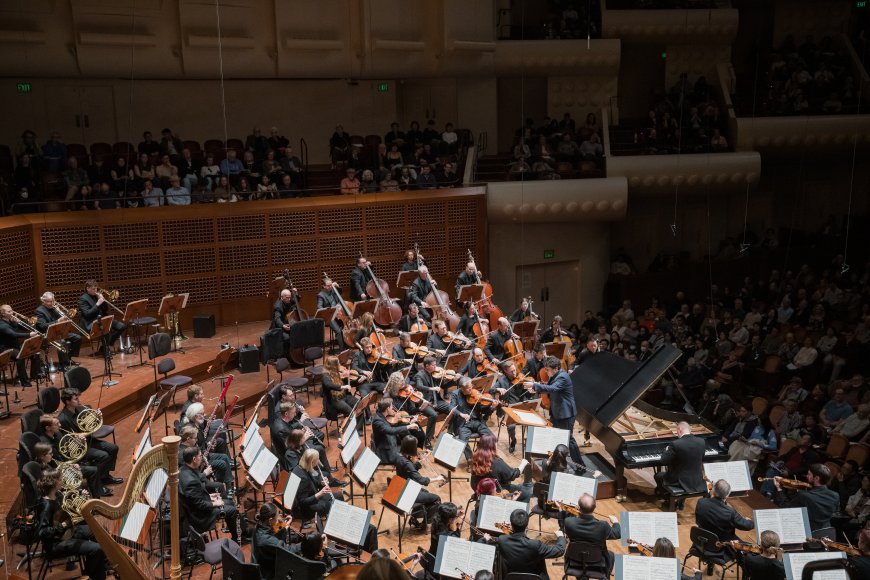
Liszt’s larger works for piano and orchestra (besides the two piano concertos, there is also the Totentanz) are, unfortunately, encountered less frequently in the concert hall than the piano concertos of other Romantic and late-Romantic composers (Schumann, Grieg, Brahms, Tchaikovsky, Rachmaninoff). Yet Liszt’s Second Piano Concerto in A major, in particular, is a fascinating work and— as last night’s enthusiastic applause from the audience proved—an utterly gripping and compelling composition. The Macedonian pianist Simon Trpčeski is its eloquent and subtly virtuosic advocate.
The way Trpčeski evokes the sometimes lyrical, then again more angular treatment of the core theme—at times surrounding it with crystalline runs, then stretching, shortening, and varying it as it is integrated into powerful chords—is a marvel of pianistic gift. Here, attack stands alongside sparkling cascades; the solo cello and the piano (and later the solo violin) meet in poetic, songful, dreamlike togetherness. This is shortly thereafter replaced by a brash gallop and a march-like elevation of the core theme, with virtuoso playing by the soloist and refined glissandi.
Striking is how the master at the piano repeatedly seeks and finds eye contact not only with the conductor, but also seems to embrace the orchestra’s musicians with his affectionate glances (and, during the final applause, physically as well)—and this despite the fact that the soloist is granted hardly a moment of rest in this concerto. For Trpčeski, as for Thomas Guggeis, this was the first appearance in the large hall of the Tonhalle Zürich. However, Trpčeski had already played Liszt’s piano concerto once before, in 2018, on a tour with the Tonhalle Orchestra.
As an encore, the two musicians, Guggeis and Trpčeski, sat down together at the piano and, with obvious pleasure, played Ravel’s Laideronnette, impératrice des pagodes from Ma mère l’Oye for piano four hands. Wonderful.

Prokofiev's Piano Concerto No. 3 , the most famous of his five concertos, is a true test of virtuosity for the soloist. From the frenetic first movement, the electrifying tone that conductor and pianist would adopt as the premise of their performance was immediately clear, all without sacrificing clarity of expression. Simon Trpčeski himself, when addressing the audience before playing a couple of encores, mentioned that he was celebrating his twenty-fifth anniversary as a performer, so perhaps it would be somewhat redundant to comment here on how technically and expressively impeccable his interpretation was. Furthermore, he possesses a natural charm that makes him a delight to the audience when he is on stage. The variations in the second movement were very elegant, and the third movement was exciting in its tempo. The ovations for Trpčeski were well-deserved, and he immediately shared them with the orchestra and the conductor.

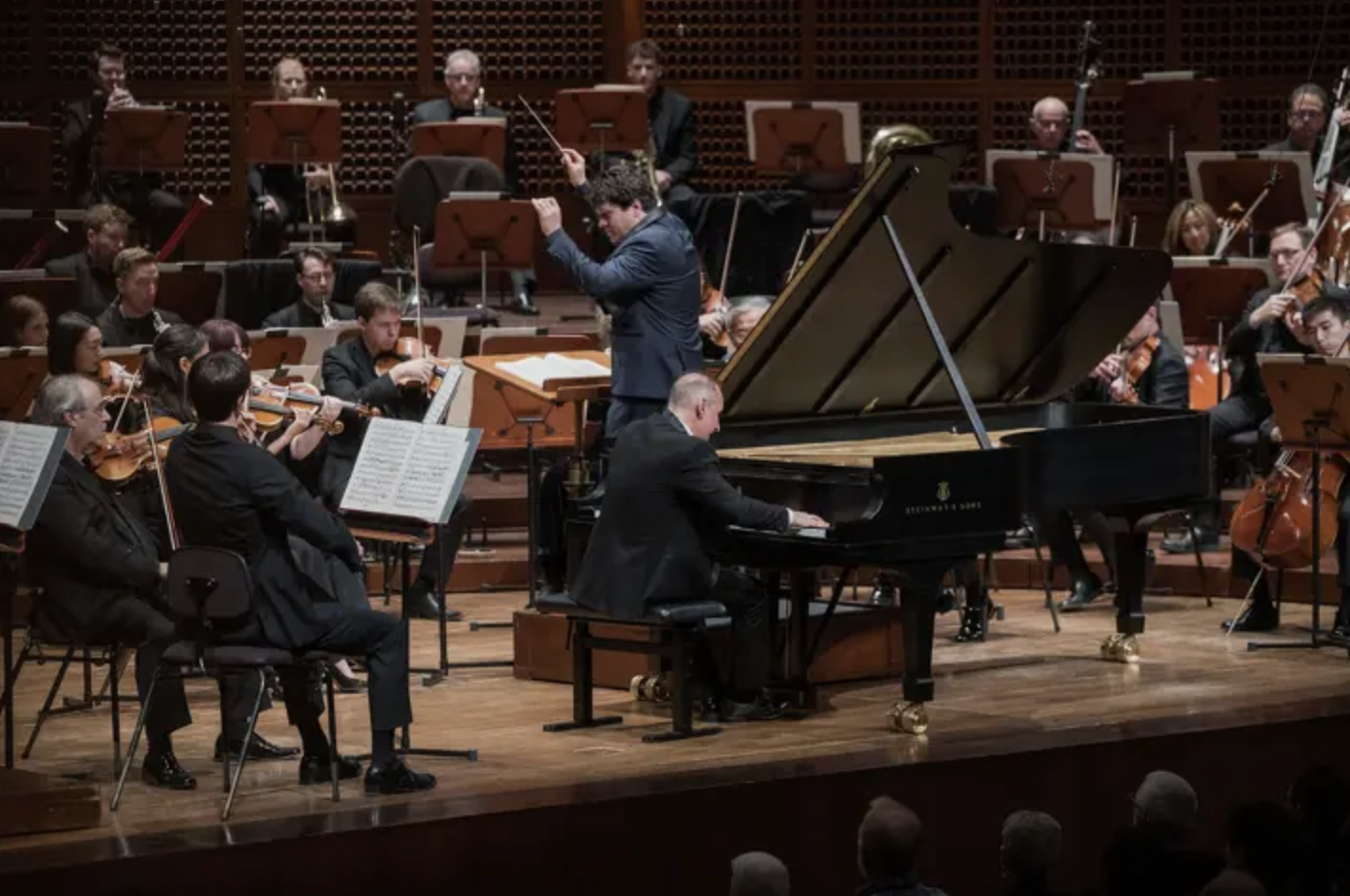
Composed in 1921, Prokofiev 's Third Piano Concerto balances virtuosity and satire, modernity and classical structure. Simon Trpčeski ( Skopje, 1979), a pianist with a solid international career and a frequent guest of leading European orchestras, approached the work with extraordinary energy and expressiveness . From the opening bars, he imposed a brilliant sound and decisive attack, with precise articulation, though at times more urgent than crystalline.
The Theme and Variations displayed flexibility and subtle nuance; the final Allegro ma non troppo , a burst of controlled energy, alternated humor with lyricism without losing its pulse. Petrenko's touch, dynamic range, and almost improvisational naturalness completed a portrait of great vitality. He accompanied with rigor and ease, underscoring the rhythmic architecture without stifling the piano's expression. The Royal Philharmonic, supple and with a pristine sound, responded with cohesion and precision, especially the woodwinds, which displayed extraordinary agility.
A score delivered with humor, dynamism, and elegance. The audience enthusiastically rewarded Trpčeski, and the pianist responded with "Dance of the Peppers," a rhythmic Macedonian dance. As if the impressive performance he had given in the concert and dance hadn't been enough, he then dared to tackle the tremendous Precipitato from Prokofiev's Seventh Sonata , dedicating it to Alfonso Aijón in fine Spanish. A breathtaking interpretation, so intense that it drew a standing ovation.

The soloist for the occasion was the Macedonian Simon Trpčeski (Skopje, 1979), whom we had already admired in the same Ibermúsica series, also accompanied by Petrenko (with the Oslo Philharmonic on that occasion) six years ago. And Trpčeski generously displayed his many virtues. As we noted then, his instrument is superb, as are his attention to sound, the variety of nuances, and the intensity of his playing. The Macedonian imbues his interpretations with remarkable energy, resulting in a very special vibrato, although at times (the aforementioned dazzling allegro ) he slightly sacrifices the clarity of an articulation that is, in reality, exquisite. But his refined sensitivity allows him to unleash the full range of expression that Prokofiev demands, from the tranquil beginning to the electrifying voltage of the allegro.
Trpčeski displayed an exquisite leggiero touch , also frequently requested by Prokofiev, and great subtlety in his nuances. It is difficult to resist that vibrant energy upon which he builds a sweeping conclusion to the first movement. The central Theme with Variations demonstrated this delicacy in the leggierisimo (Variation I), but also allowed one to appreciate the capacity to offer forcefulness (Variation III) or mystery (Variation IV, with a truly delicatissimo , as Prokofiev demands, and an evanescent ppp at the end) and a suspended mixture of smile and almost mystery in the movement's final section. The final Allegro ma non troppo was another feast of rhythm and color , with a beautiful, more lyrical episode ( Meno mosso ) magnificently drawn by Petrenko. The grotesque atmosphere was superbly presented with the aforementioned four-note figures, and the ending, with its overwhelming trepidation, was received with predictable enthusiasm by the audience. Petrenko accompanied the soloist with remarkable precision and incisiveness, demonstrating a clear and fluid understanding. The orchestra responded with agility, remarkable blend, and rich sound. The woodwind soloists shone particularly brightly, but the entire ensemble delivered an enviable performance.
Trpčeski, always approachable and fluent in Spanish, briefly explained that he would next perform the Pepper Dance, a popular Macedonian dance that forms part of his commitment to promoting the folk music of his country (the Makedonissimo project, in which he participates with other compatriots). The short piece added even more color and rhythm to an afternoon they were already in control of. But this must have seemed like too little of an encore, and in another brief address, he announced another special treat dedicated to Alfonso Aijón (who received a well-deserved standing ovation). And what an encore it was! None other than the tremendous, tense, obsessive, and heart-wrenching Precipitato from Prokofiev's Seventh Sonata , presented with an intensity that leaves you on the edge of your seat.

This 2010 recording can enrapture us with its ideal mix of sensitivity, warmth, balance and generosity, and its sense of give and take. Trpčeski, conductor Vasily Petrenko and the Royal Liverpool Philharmonic create rapt atmospheres, with a freshness of response that seems to spruce up the concerto as if new-minted. There's exemplary attention to detail, but also a gorgeous spontaneity; you feel that the performers are having the time of their lives. The RLPO plays with luxuriant richness of tone that manages also to keep its transparency, aided by fine recorded sound. (Avie AV2192)

As it’s so well-known, it needs a soloist who can breathe new life into it and who has the right mix of fiery virtuosity and poetry. Soloist Simon Trpčeski not only had plenty of fire in his fingers for the dazzling pyrotechnics but he was able to wring every bit of emotion from the heart-on-sleeve lyrical sections. Simon was also extraordinary to watch. The way he establishes relationships with audience, conductor and orchestra is fascinating. In this performance he coaxed a huge range of colours from the keyboard, always completely in control of what he was doing, right up to the final note at which he sprang off the piano stool. The audience’s cheers led to more Grieg as an encore.