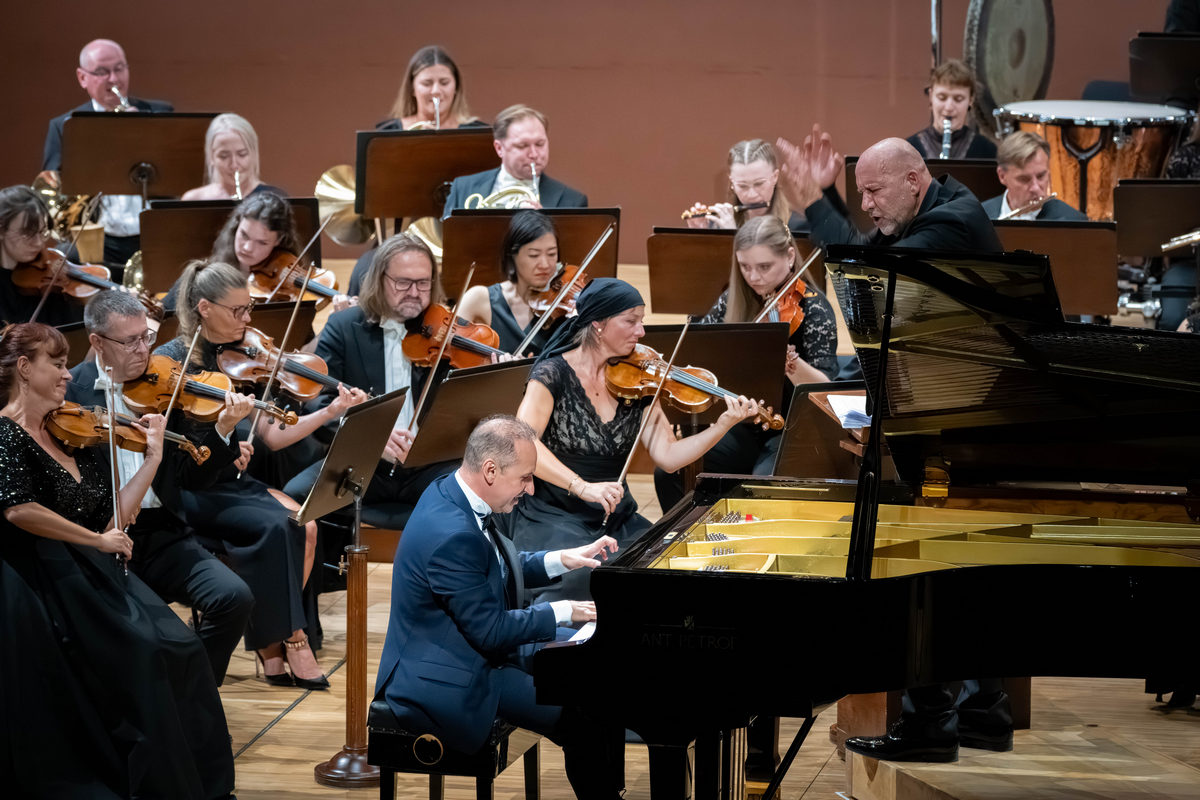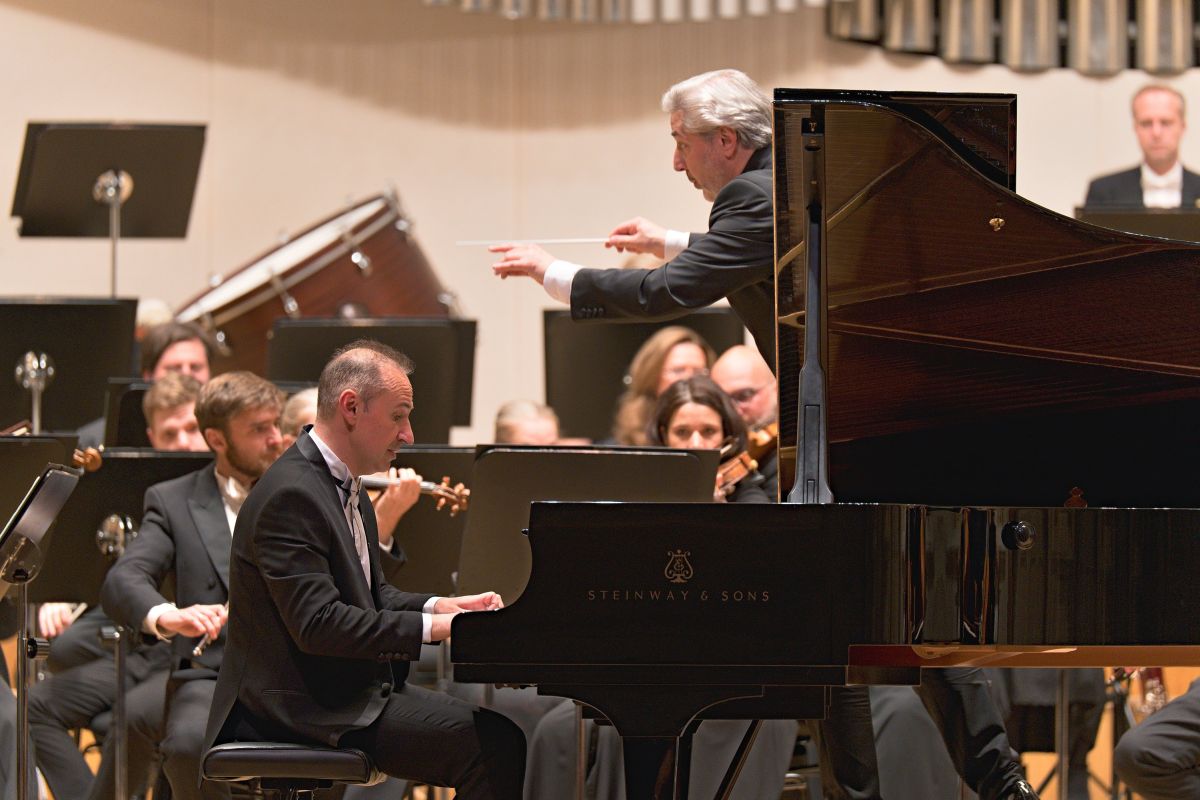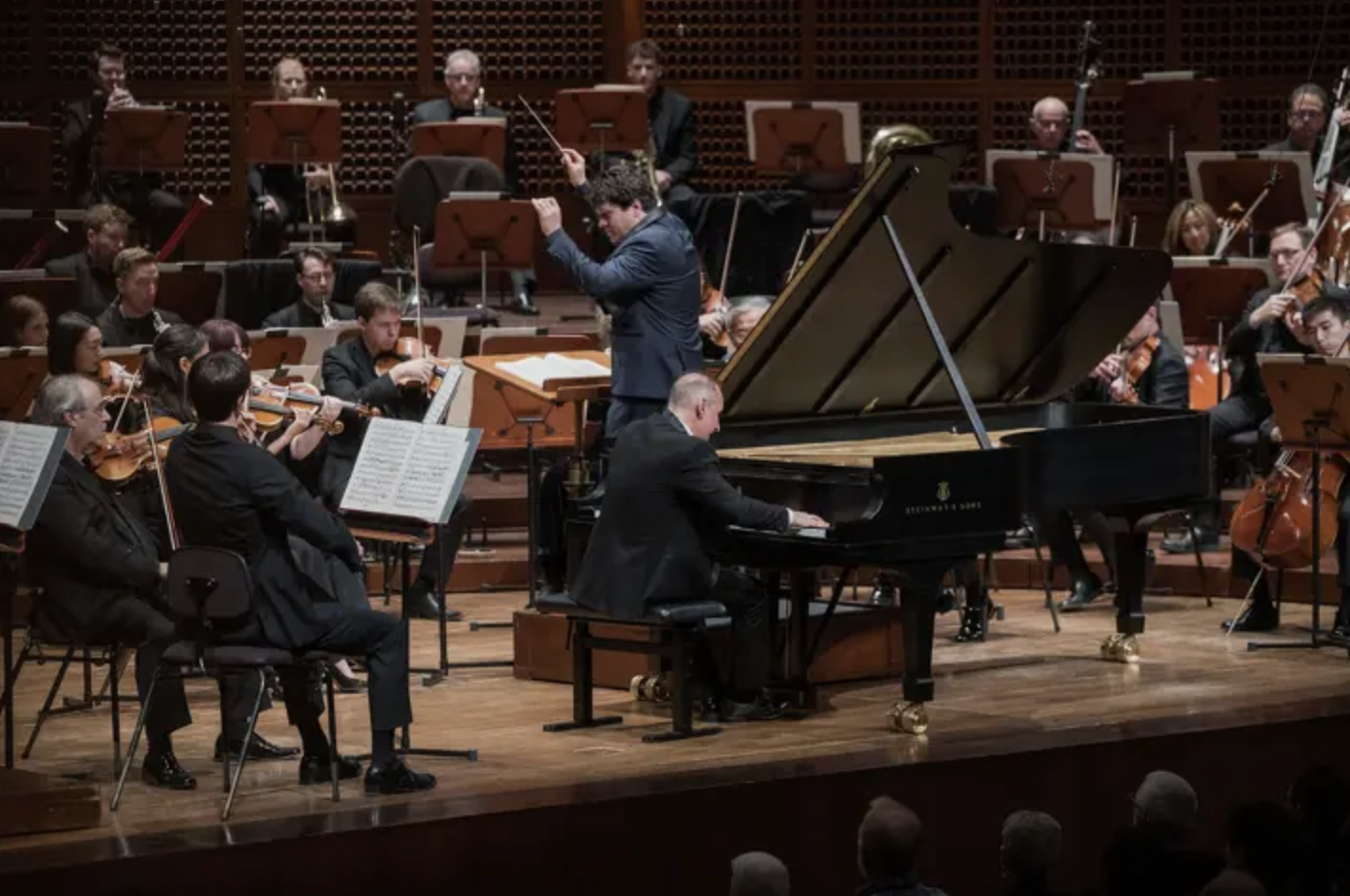
When Sergei Prokofiev wrote his Piano Concerto No. 3 in C Major, he was around thirty years old and living in the West, attempting to shed his image as the enfant terrible of Russian music. For pianist Simon Trpčeski, the wild rhythms and harmonics of the composer’s early compositions were dominant as he played the concerto Sunday afternoon with the Palm Beach Symphony under Gerard Schwarz at the Kravis Center.
For sheer digital skill and command, Trpčeski is in a league of his own. No matter how fast the tempo, every note has clarity and is perfectly placed. Sometimes that kind of monster technique does not always fit the music’s profile. At the piano’s first entrance in the Prokofiev concerto, Trpčeski took off at a headlong clip. Volleys of notes were dispatched with aplomb and daredevil flair. There were moments when he lightened his touch and allowed tonal coloring to buttress his pianistic power. Schwarz and the highly responsive orchestra managed to keep up with the soloist.
The Macedonian pianist was at his most eccentric during the theme and variations of the Andantino. Fast sections were frantic, slow episodes stretched to extremes. Despite his quirky phrasing, the Allegro ma non troppo finale played to the pianist’s strengths—pounding power, showmanship, brio and flawless articulation. The totality of his reading proved rather exhausting but, undeniably exciting. Schwarz highlighted Prokofiev’s instrumental hues and felicities. In the finale’s lyrical central section, he drew silken sonority from the strings.

Pianist Simon Trpčeski has been billed as “the best thing to come out of Macedonia since Alexander the Great”.
While Trpčeski has never invaded Persia, he shares with his fellow Macedonian a certain uncomplicated boldness and a flair for the conquest of difficult obstacles, as evidenced by his fresh, athletic performance of Rachmaninoff’s second piano concerto with a well-oiled Singapore Symphony Orchestra (SSO) under the inspired nonagenarian conductor Eliahu Inbal.
This was a performance of dynamism, dexterity and Mediterranean directness, not the hypnotic concentration of a Sviatoslav Richter or the patrician eloquence of a Garrick Ohlsson (who played the work with the SSO in a very different interpretation two years ago).
Trpčeski is a natural showman who reveled in tricky passages with the elan of a magician pulling a rabbit out of a hat. The outer movements were taken at a thrilling pace, to great effect in more frenetic moments such as the piano’s keyboard-spanning entrance in the last movement.
However, the same movement’s coda felt less like an exhilarating summit push and more like a breathless scramble towards the finish line.
There were a few uneasy moments in the first movement, with Trpčeski’s lithe, clean sound sometimes failing to project adequately over the orchestra. One also missed the neurotic heartsickness at the core of the work, particularly in the second movement, whose long-spun melodies often felt declamatory rather than confessional.
This was not helped by Inbal and the SSO’s tendency to insert pauses that felt just a shade too precious between each bar of the main theme.
Nonetheless, it was a brilliant, energetic performance that earned a well-deserved standing ovation.
Trpčeski's two encores were exceptional. The last movement of Prokofiev’s 7th sonata was delivered with jaw-dropping technique and all the deranged automatism of the assembly line in Chaplin’s Modern Times.
The second was a performance of Rachmaninoff’s Vocalise in which Trpčeski accompanied guest concertmaster David Coucheron. It was prefaced by some engaging remarks about Trpčeski's love of Singapore and music’s peace-making powers amid world disorder, and was as unexpected as it was touching.

On September 4, 2025, the Prague Philharmonia Orchestra will open its season in the Dvořák Hall of the Rudolfinum with Simon Trpčeski performing the Saint-Saëns' "Egyptian Concerto" No. 5. In this interview, Trpčeski discusses historical context of the work, his experience with the Czech audiences, his broad repertoire and interpretive approach, MAKEDONISSIMO and his cultural heritage, and his mission as an artist.

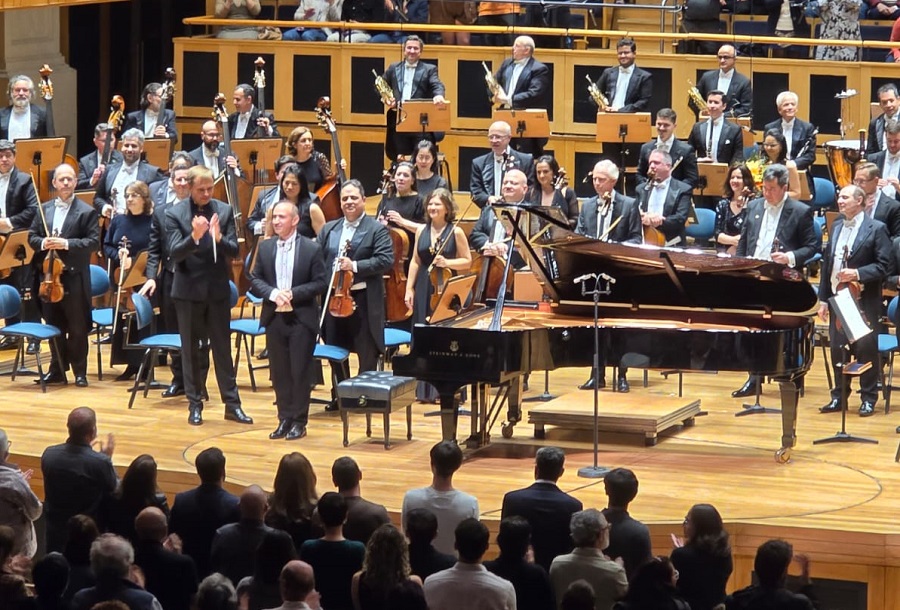
The concert series kicked off with a recital on July 13, after which for three evenings (from July 17 to 19) as a soloist with the São Paulo Symphony Orchestra, under the baton of the celebrated maestro Vasily Petrenko, Trpčeski performed Tchaikovsky's Piano Concerto No. 1. The Brazilian audience greeted each performance with ovations, and a real curiosity for the Macedonian flags in the audience. Trpčeski responded to the warm reception with encore performances of Villa Lobos, Bužarovski, and excerpts from "Makedonissimo." The concerts were supported by the President of the Macedonian-Brazilian Chamber of Commerce, Luis del Valle.

The Budva audience welcomed the concert with enthusiasm and expressed great respect for the performers, which resulted in the performance of two encores, with standing ovations and strong emotions that rounded off an exceptional musical evening. Trpčeski said after the concert that a natural and spontaneous audience is always a gift for an artist. "This is not a classical project, it should be spontaneous. As you saw, I'm also in a role narrator and that is the point of the "MAKEDONISSIMO" project - to really embrace people through music," said Trpčeski and added that he was grateful to the Grad Teatar festival. "Thank you for inviting us, for giving us this honor to open the music program of this year's festival. We hope that our collaboration will continue."
_KulturOp_L.Saveski_1_C.jpg)
Renowned Macedonian pianist Simon Trpčeski will perform at Bratislava's Reduta on June 12 and 13, accompanied by the Slovak Philharmonic Orchestra led by conductor Daniel Raiskin. In an interview with MusicPress.sk, Simon discusses his heritage and relationship with Macedonian music, his experiences from a recent concert in Chile, the importance of cultural diplomacy, and what attracted him to Slovak culture, in which he sees many influences and historical impact.

President Gordana Siljanovska Davkova attended a concert by pianist Simon Trpceski in Rome last night at the event called Macedonia in Honor of Saint Cyril. She said such events are a reminder of the power of cultural diplomacy. The president stated, "I am speechless. First of all, the atmosphere at Horti Salustiani is wonderful, not to mention Simon Trpčeski and his band. Of course, in addition to Tchaikovsky and Grieg, they also performed Makedonissimo. I think all the excellencies present from the embassies, the representatives of our diaspora, not only in Italy, but also from other countries, were speechless," said President Siljanovska Davkova.

The Thessaloniki State Orchestra appeared on Saturday, May 17, 2025 for the first time in its history in the city of Skopje. The concert featured the celebrated Macedonian pianist, Simon Trpčeski. It was a gathering that promoted friendship and cooperation between two cultures. The concert was enthusiastically received, as the audience in Skopje filled the Macedonian Philharmonic Hall, and at the end expressed their enthusiasm with a standing ovation. The President of the Macedonia, Gordana Silianovska, was in attendance and she warmly congratulated the performers after the concert, while also making a statement that the event "enthusiastically captivated the audience and demonstrated the enormous power of art as cultural diplomacy."

Thessaloniki State Orchestra (SSO) performed in Skopje, Macedonia for the first time in its 66-year history. The concert featured Macedonian pianist Simon Trpčeski and Greek conductor Vladimir Symeonidis. Among the hundreds of spectators was the President of Macedonia, Gordana Siljanovska, who stated that she was moved by the concert and its message. "I deeply believe in the power of cultural diplomacy. I am sure that sometimes - or rather always - this form of diplomacy is more effective than traditional diplomacy. So I think that perhaps, little by little, through music, we will realize how similar we are and that there are indeed no obstacles that cannot be overcome," said Ms. Siljanovska upon arriving, while also invoking Nietzsche's phrase: "Without music, this world would be a mistake." Trpčeski emphasized, "Music crosses borders and creates friendships. There is no other force that can do this. People have choices... We can choose to be happy, to cooperate, and to bridge our differences. And that makes me very happy." He performed Ravel Piano Concerto in G to an appreciative audience.

The Thessaloniki State Symphony Orchestra performed for the first time in its 66 years of existence last night at the Macedonian Philharmonic, with conductor Vladimiros Simeonidis, in front of distinguished guests - among them President Gordana Siljanovska-Davkova and Foreign Minister Timcho Mucunski. Simon Trpčeski played the elegant and precise Ravel Piano Concerto in G major. It was an important and inspiring collaboration between the Macedonian and Greek artistic cultures.

Macedonian pianist Simon Trpceski last appeared here in 2013, performing at the Singapore International Piano Festival and with the Singapore Symphony Orchestra. His most recent solo recital, presented by Altenburg Arts, showed that time has not dimmed the memory of an artist who has very personal ideas about music, married with a transcendental technique that invites superlatives. Trpceski has the ability to persuade, winning the listener over with beauty of tone and no little force of personality.
There were five encores in total, by Prokofiev (Scherzo Humoristique, Op. 12 No. 9), Rodion Shchedrin (Humoresque), a Macedonian folksong (Don’t Sell Y our Estate, Koljo) and lovely duets by Debussy and Brahms with two of Singapore’s young talents Maxim Oswald-Lim and Theodore Penn Hur. It was simply charming.

Macedonian pianist Simon Trpčeski is now a regular guest at Slovenian concert halls. That is why it is easier to draw a complete picture of his musical personality, which is broad. The concert was relatively short, but it was extended with the pianist's encores. The program primarily focused on romantic miniatures, but the pianist's post-concert presentation at the piano turned into a modern, watercolors of modernity. The latter can be considered the pianist's basic stance. Trpčeski seems primarily a poet of the piano.