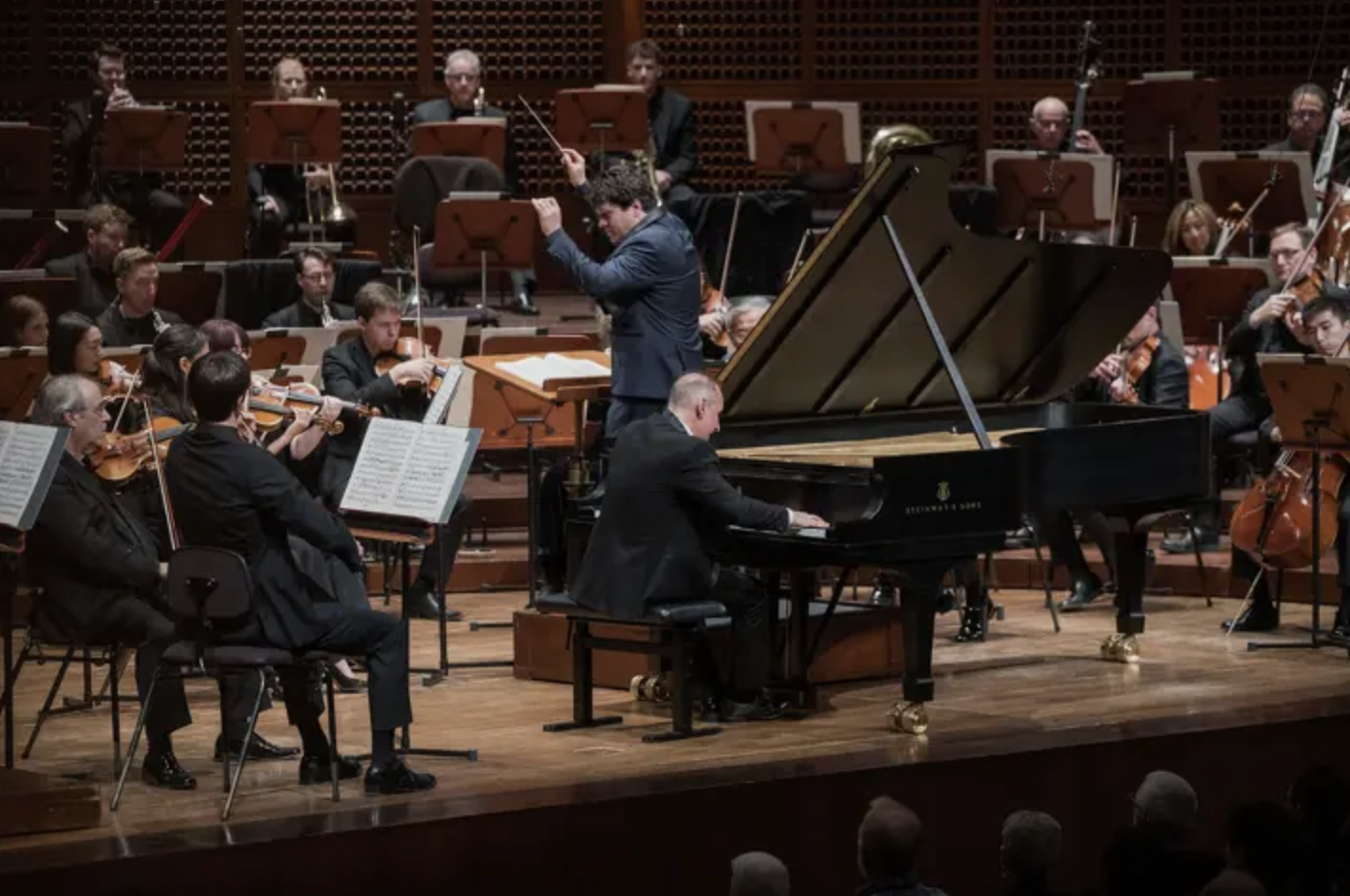
The evening's centerpiece, Tchaikovsky's Piano Concerto No. 1, marked a second debut at the Lingotto: that of Simon Trpčeski (Skopje, 1979), one of the most recognized pianists on the international scene. A masterful artist combining breathtaking virtuosity and intense musicality, Trpčeski trained in Macedonia before coming to the attention of the general public in the early 2000s with his London debut at Wigmore Hall and his selection as a BBC New Generation Artist, a decisive step in the launch of an international career. Since then, he has appeared with major European and American orchestras and collaborated with leading conductors, authoritatively tackling a repertoire ranging from Chopin and Brahms to the twentieth-century works of Prokofiev and Rachmaninoff. Alongside his concert activity, his cultural commitment stands out: with the Makedonissimo project he has brought the Macedonian musical tradition to the international stage, affirming an artistic personality both open and deeply rooted in his own identity.
His style reveals an energetic yet controlled pianism, attentive to formal construction and lyricism. Tchaikovsky's performance is less turgid than usual, with an almost Mozartian elegance—no coincidence, considering the Russian composer's love for the Salzburg genius, revered as a model of formal and expressive perfection and consciously honored in The Queen of Spades. After the monumental, solemn, and visionary attack, the piano asserts itself as a protagonist, never purely exhibitionistic: the dialogue with the orchestra remains intense, alternating between heroic momentum and intimate lyricism. In Trpčeski's interpretation, the concerto combines controlled emotional impetus, melodic invention, and a communicative force of marked theatricality.
In the two encores, persistently requested by the audience, the pianist once again returned to the Makedonissimo project , performing the lively Piperkovo (Paprika Dance), which he himself had developed; the even more impetuous Precipitato from Prokofiev's Sonata No. 7 was even more compelling. Before his final farewell, Honeck and the Santa Cecilia Orchestra offered a rousing Brahms's Hungarian Dance No. 1, capping off an evening that was, in many ways, memorable.

Orthodox New Year's Eve, Saturday 13 January 2024, 20:00h Auditorium Rainier III, Monaco
MAKEDONISSIMO - Transcriptions of traditional Macedonian music by Pande Shahov in collaboration with Simon Trpčeski
Pande SHAHOV - Pletenki: Plaits (Les tresses)

The German Record Critics' Prize presents the current longlist 1/2024. The currently 154 critic jurors have nominated a total of 292 new releases from the last quarter in 32 categories that are eligible for the next best list. The 1/2024 leader board will be published on February 15th. Longlist 1/2024 Jury concerts...-Brahms: Piano Concertos No. 1 & 2. Simon Trpčeski, WDR SO, Cristian Măcelaru (Linn)...

The critics of this newspaper (film, theater, art, music and literature) chose ten of the most successful works from fields that were shown, performed, published or organized this year in Serbia.

Simon Trpčeski’s playing has always had a touch of brilliance, which has ample chance to glitter, but he doesn’t stint on the requisite grandeur of sound. Granitey octaves often alternate with rounded legato; and his sense of rubato is superb, with a subtle holding-back at key moments, as in the second theme of the D minor’s first movement. There’s a beautiful sense of balance and line, phrased with a natural ebb and flow while bringing out the songfulness. He and Măcelaru seem to bounce ideas off one another as the character of the themes emerges and gels. — Jessica Duchen, BBC Music Magazine

Soloist Simon Trpčeski showed full command of the piano part, skilfully negotiating its avowedly awkward keyboard writing. The piano’s relation to the orchestra alternates between consolation and confrontation. He managed both, but was more impressive in the former. The tremendous sense of struggle in the work, especially in its long and eventful first movement, was slightly muted on this occasion, despite some potent playing of its chromatic trills and double octaves. However, Trpčeski was fully satisfying in the subsequent movements. The Adagio was a benediction, appropriately so since the manuscript is inscribed Benedictus qui venit in nomine Domini. Whether or not that refers to the tragedy of Robert Schumann, this was affecting pianism. Trpčeski set a lively tempo in launching the finale, the élan in his playing and that of the LSO earning a heartfelt cheer from the packed house.

Making his second visit to Tasmania, Macedonian pianist Simon Trpčeski took on one of the really big pieces in the concerto repertoire – the Brahms Piano Concerto No. 2 in B flat, Op. 83. He brought both ardour and strength to bear on this grand work, but also an unexpected fluent delicacy to many passages where a heavier approach is often taken.He brought both ardour and strength to bear on this grand work, but also an unexpected fluent delicacy to many passages where a heavier approach is often taken.He brought both ardour and strength to bear on this grand work, but also an unexpected fluent delicacy to many passages where a heavier approach is often taken.

The remarkable double act returns! Britten and Pears? Morecambe and Wise? No, it’s the Macedonian pianist Simon Trpceski and the Romanian conductor Cristian Macelaru, last seen delighting us with Shostakovich’s two piano concertos, now doing the same with the pair by Brahms. Each work is a repertoire colossus, though with these musicians even the most jaded listeners must come away not just refreshed, but excited as well.

This is oratory Brahms and it takes a big player, such as Trpčeski certainly is, to do it justice. The movement’s opening horn/woodwind motif is perfectly played by the members of the WDR Sinfonieorchester and Trpčeski responds with a commanding cadenza, his shifts of tempo always well judged. Note the assertive tutti that follows, the superbly balanced bassoon-led woodwinds at 2'28", then the swinging pendulum at 2'56" (a typically Brahmsian gesture). In the scherzo Trpčeski proceeds towards the big central tutti, where Cristian Măcelaru holds the pace steady, then in the slow movement the pianist’s rapturous response to the solo cellist’s theme (more beautiful playing, I presume by Oren Shevlin) is extremely moving. The finale on the other hand is transparent and crisp.

Trpceski's entry was modest but warm, with endless time to work over gentle phrases. Limpid expression asked little of the audience save to let the music wash over & immerse the hall. Brahms' muse, Clara Schumann, might have been present in the woodwind chorale that drifted in over rumbling piano before a fresh spark reignited the attack in majestic melody & harmony. Between solos Trpceski seemed to be shaping the sound as if conducting, returning to the keyboard for ethereal meanderings; lifting in cadenza-like flurries then fading to a chordal ensemble cadence.Launching instantly into the Rondo finale, Trpceski attacked with verve & virtuosic flair, handing off to the orchestra for another mood swing and frenzy of notes.All were spectators for a brilliant cadenza display that drew the orchestra into a final canter through blistering runs to a bombastic conclusion.

Transcriptions of Macedonian traditional music
by Pande Shahov in collaboration with Simon Trpčeski
23.10.2023 / Sombor, Serbia / Somus Festival / Svečana sala Gradske kuće / 19:00h / Concert details
24.10.2023 / Zagreb, Croatia / Vatroslav Lisinski Concert Hall / 20:00h / Concert details
26.10.2023 / Novi Sad, Serbia / Nomus Festival / Sinagoga, Novi Sad / 20:00h / Concert details
28.10.2023 / Timișoara, Romania / Filarmonica Banatul Timișoara - Sala Capitol / 19:00h / Concert details