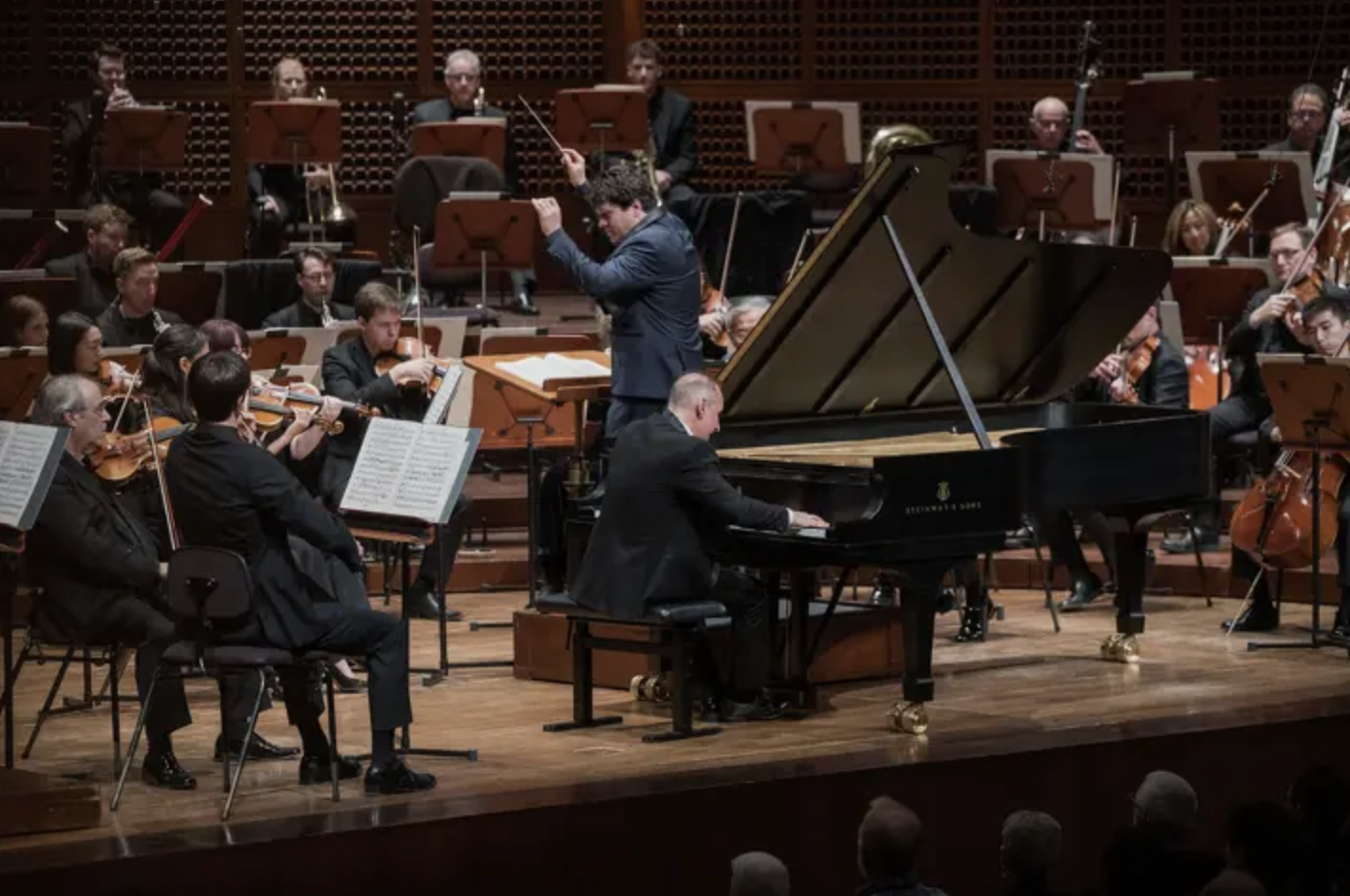
The evening's centerpiece, Tchaikovsky's Piano Concerto No. 1, marked a second debut at the Lingotto: that of Simon Trpčeski (Skopje, 1979), one of the most recognized pianists on the international scene. A masterful artist combining breathtaking virtuosity and intense musicality, Trpčeski trained in Macedonia before coming to the attention of the general public in the early 2000s with his London debut at Wigmore Hall and his selection as a BBC New Generation Artist, a decisive step in the launch of an international career. Since then, he has appeared with major European and American orchestras and collaborated with leading conductors, authoritatively tackling a repertoire ranging from Chopin and Brahms to the twentieth-century works of Prokofiev and Rachmaninoff. Alongside his concert activity, his cultural commitment stands out: with the Makedonissimo project he has brought the Macedonian musical tradition to the international stage, affirming an artistic personality both open and deeply rooted in his own identity.
His style reveals an energetic yet controlled pianism, attentive to formal construction and lyricism. Tchaikovsky's performance is less turgid than usual, with an almost Mozartian elegance—no coincidence, considering the Russian composer's love for the Salzburg genius, revered as a model of formal and expressive perfection and consciously honored in The Queen of Spades. After the monumental, solemn, and visionary attack, the piano asserts itself as a protagonist, never purely exhibitionistic: the dialogue with the orchestra remains intense, alternating between heroic momentum and intimate lyricism. In Trpčeski's interpretation, the concerto combines controlled emotional impetus, melodic invention, and a communicative force of marked theatricality.
In the two encores, persistently requested by the audience, the pianist once again returned to the Makedonissimo project , performing the lively Piperkovo (Paprika Dance), which he himself had developed; the even more impetuous Precipitato from Prokofiev's Sonata No. 7 was even more compelling. Before his final farewell, Honeck and the Santa Cecilia Orchestra offered a rousing Brahms's Hungarian Dance No. 1, capping off an evening that was, in many ways, memorable.

Friendship comes out of a strong sense of belief, stemming from his country’s struggle throughout the age, his love for music, his faith in humanity’s inner strength and, above all, his friends and colleagues who made this recording happen. Mirroring this confidence-embracing approach, the neatly curated repertoire includes Brahms’s fiery Piano Quartet No. 3 in C minor, a work full of love, power and boldness. Connesson’s jaw-dropping Divertimento is presented in a fantastic newly available arrangement by percussionist Vlatko Nushev. And sandwiched between the two, Pande Shahov’s three-movement Quintet ends in a triumphant manner.

Born in Skopje, virtuoso pianist Simon Trpčeski is one of the most sought-after pianists today! With his powerful pianism and deeply expressive and unique interpretations, he won not only the hearts of listeners in concert halls around the world, but also left critics with only one choice: reviews of his concerts are turned into panegyrics! He performed as a soloist with the world's largest orchestras such as the New York Philharmonic, the San Francisco Symphony, the City of Birmingham Symphony Orchestra and the London Royal Philharmonic Orchestra, with whom he performed last season in the Lisinski Saturday cycle.

Macedonian pianist Simon Trpčeski and his international group also treated us to a newish piece by another Macedonian, Pande Shahov, in a nicely-proportioned programme that started with high seriousness and ended with a fluffy-light soufflé.

The pair began with Mozart’s Violin Sonata in E minor K304 – a genial, if subdued opening. Vengerov’s rivers of legato were even more delectable when combined with the sonorities from his 1727 ‘Kreutzer’ Stradivari. Prokofiev’s First Violin Sonata upped the temperature considerably, with Vengerov in high-concentration mode during the eerie filigree passages. Rough-hewn lunges during the second movement were tempered with sweetness, while Trpčeski felt like an amiable demon at the piano. The mellow, introspective Andante eventually yielded to the reprise of the violin filigree in the finale, returning like a love letter.

Listen to Simon Trpčeski's interview on BBC Radio 3's In Tune together with Maxim Vengerov talking about their upcoming concert on January 10 in London's Barbican Hall. January 7 at 17:00 GMT / 18:00 CET

The wondrously talented Macedonian pianist Simon Trpčeski opens daringly with Brahms’s wistful Intermezzo, Op117, before a dazzlingly reading of the Op24 Variation and Fugue on a theme by Handel. Then the totally different soundworld of Ravel’s Valses nobles et sentimentales bursts forth in all its dizzying glamour, before a selection of Poulenc’s charming Novelettes and Improvisations brings this masterly recital to a classy close. A disc to savour. Highly recommended.