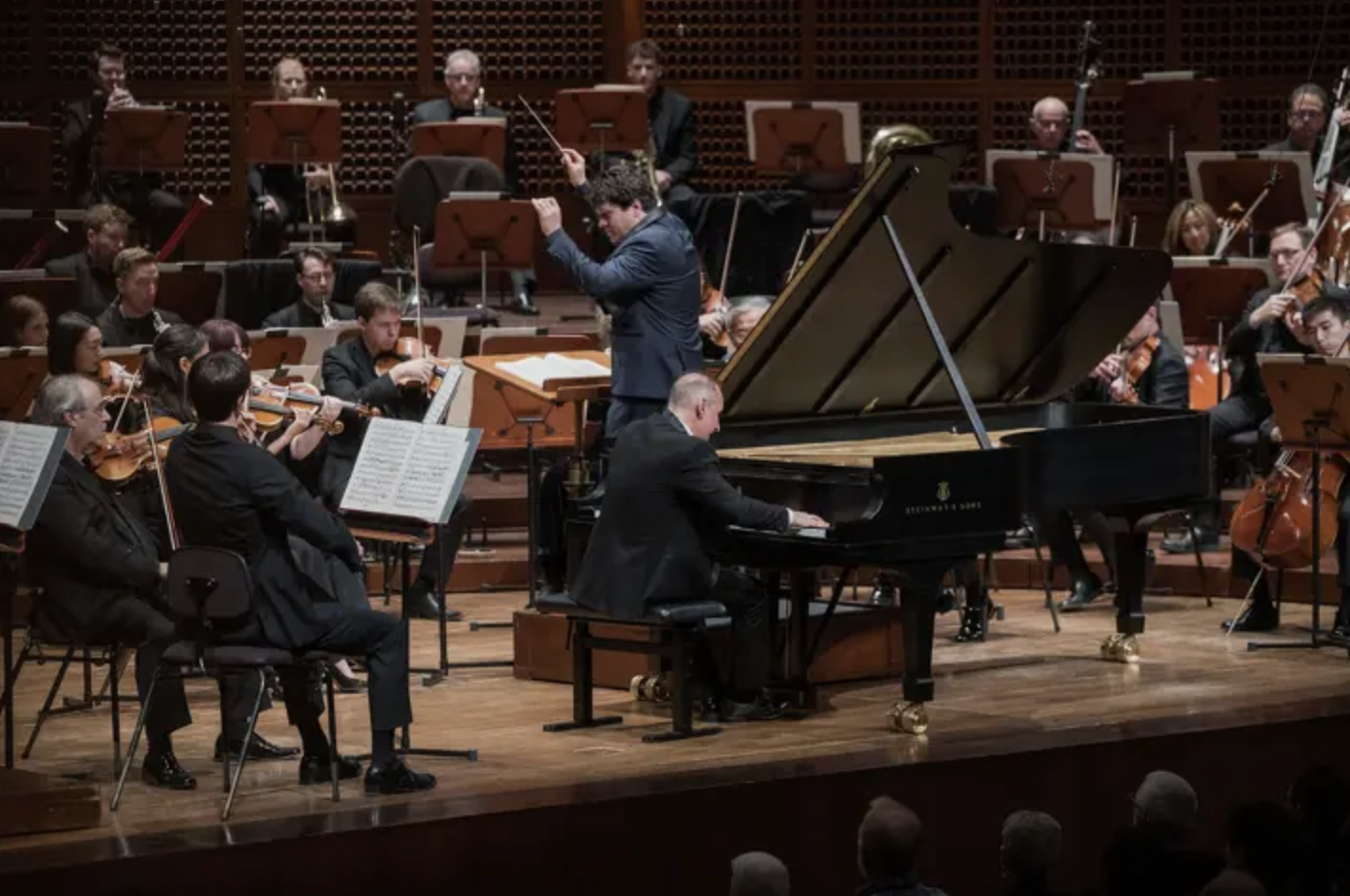
When Sergei Prokofiev wrote his Piano Concerto No. 3 in C Major, he was around thirty years old and living in the West, attempting to shed his image as the enfant terrible of Russian music. For pianist Simon Trpčeski, the wild rhythms and harmonics of the composer’s early compositions were dominant as he played the concerto Sunday afternoon with the Palm Beach Symphony under Gerard Schwarz at the Kravis Center.
For sheer digital skill and command, Trpčeski is in a league of his own. No matter how fast the tempo, every note has clarity and is perfectly placed. Sometimes that kind of monster technique does not always fit the music’s profile. At the piano’s first entrance in the Prokofiev concerto, Trpčeski took off at a headlong clip. Volleys of notes were dispatched with aplomb and daredevil flair. There were moments when he lightened his touch and allowed tonal coloring to buttress his pianistic power. Schwarz and the highly responsive orchestra managed to keep up with the soloist.
The Macedonian pianist was at his most eccentric during the theme and variations of the Andantino. Fast sections were frantic, slow episodes stretched to extremes. Despite his quirky phrasing, the Allegro ma non troppo finale played to the pianist’s strengths—pounding power, showmanship, brio and flawless articulation. The totality of his reading proved rather exhausting but, undeniably exciting. Schwarz highlighted Prokofiev’s instrumental hues and felicities. In the finale’s lyrical central section, he drew silken sonority from the strings.

Pianist Simon Trpčeski has been billed as “the best thing to come out of Macedonia since Alexander the Great”.
While Trpčeski has never invaded Persia, he shares with his fellow Macedonian a certain uncomplicated boldness and a flair for the conquest of difficult obstacles, as evidenced by his fresh, athletic performance of Rachmaninoff’s second piano concerto with a well-oiled Singapore Symphony Orchestra (SSO) under the inspired nonagenarian conductor Eliahu Inbal.
This was a performance of dynamism, dexterity and Mediterranean directness, not the hypnotic concentration of a Sviatoslav Richter or the patrician eloquence of a Garrick Ohlsson (who played the work with the SSO in a very different interpretation two years ago).
Trpčeski is a natural showman who reveled in tricky passages with the elan of a magician pulling a rabbit out of a hat. The outer movements were taken at a thrilling pace, to great effect in more frenetic moments such as the piano’s keyboard-spanning entrance in the last movement.
However, the same movement’s coda felt less like an exhilarating summit push and more like a breathless scramble towards the finish line.
There were a few uneasy moments in the first movement, with Trpčeski’s lithe, clean sound sometimes failing to project adequately over the orchestra. One also missed the neurotic heartsickness at the core of the work, particularly in the second movement, whose long-spun melodies often felt declamatory rather than confessional.
This was not helped by Inbal and the SSO’s tendency to insert pauses that felt just a shade too precious between each bar of the main theme.
Nonetheless, it was a brilliant, energetic performance that earned a well-deserved standing ovation.
Trpčeski's two encores were exceptional. The last movement of Prokofiev’s 7th sonata was delivered with jaw-dropping technique and all the deranged automatism of the assembly line in Chaplin’s Modern Times.
The second was a performance of Rachmaninoff’s Vocalise in which Trpčeski accompanied guest concertmaster David Coucheron. It was prefaced by some engaging remarks about Trpčeski's love of Singapore and music’s peace-making powers amid world disorder, and was as unexpected as it was touching.

The wondrously talented Macedonian pianist Simon Trpčeski opens daringly with Brahms’s wistful Intermezzo, Op117, before a dazzlingly reading of the Op24 Variation and Fugue on a theme by Handel. Then the totally different soundworld of Ravel’s Valses nobles et sentimentales bursts forth in all its dizzying glamour, before a selection of Poulenc’s charming Novelettes and Improvisations brings this masterly recital to a classy close. A disc to savour. Highly recommended.